
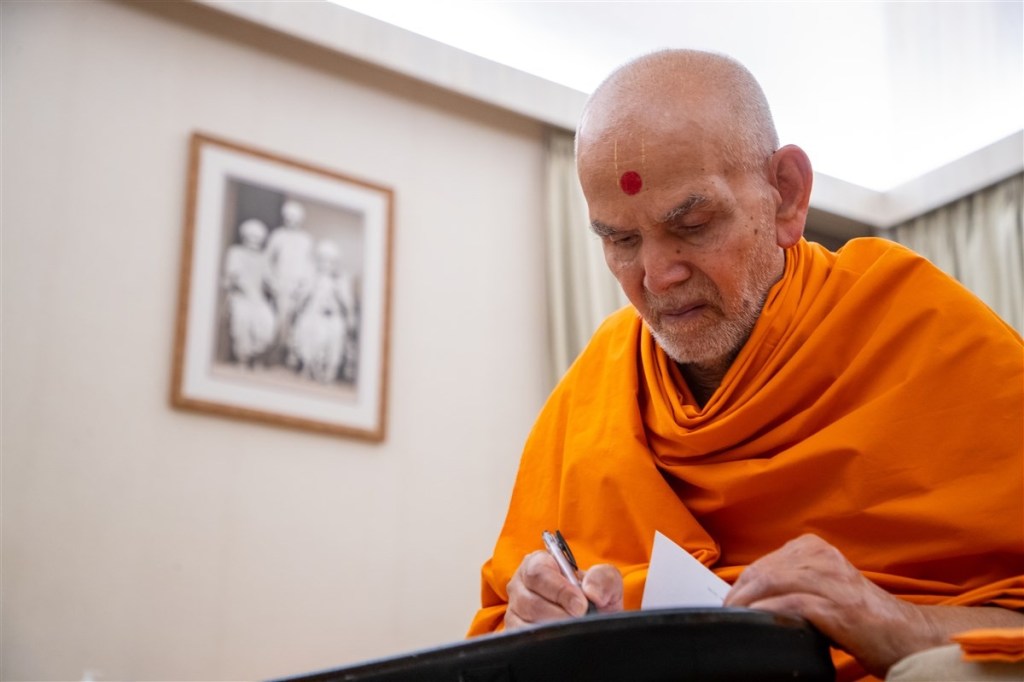
All of us have been uncertain at some point. We may have been confused, disinterested, or we may have known what we want but certainly not what we need. No one can, with any real certainty, know what they need, and perhaps that is the key to how we view the world. We know what we want for breakfast tomorrow, maybe lunch, maybe dinner, or maybe we skip all three and just know what we want to snack on all day instead of eating a real meal. We might want waffles for that meal, a sandwich for lunch, Taco Bell for dinner. Yet are we able to say the food we want is what we truly need? As satsangis, a lot of us look to Bapa for advice, for guidance, for ashirvad. Yet when we don’t get the answer we want, we recoil. We start to question if our Guru even means what he said. We try to find loopholes in his guidance rather than accepting, understanding, and moving on. To be entirely truthful, I am just as guilty of this. But how many of us actually know what the future holds? How many of us truly understand our purpose in this world, in its entirety? How many of us write that letter, send it, hoping for one answer over another? How many of us write a letter to convince ourselves that what we’ve already decided just needs to be affirmed by our Guru, so we can have peace of mind?
The intention behind writing most letters is for ashirvad. But are we asking for ashirvad in hopes that what we’ve already decided for our lives goes well, or are we asking so we can fulfill whatever purpose we serve in the best way possible? And what happens when life doesn’t go our way? We start to question everything. We question our faith rather than ourselves. We question everything and everyone else besides ourselves. The thought of “maybe I am doing something wrong” or “maybe I should do something different” never comes before “why should I believe in God and Guru when he screwed me over.” Instead of asking why we get, for lack of a better word, screwed over, shouldn’t we ask how we could have done something different? And for those who truly believe everything is in God’s hands, shouldn’t we ask what he has in store for us instead?
And the letters for guidance, what about them? Are they worded in a way where we are truly asking for guidance, or are we asking for affirmation that what we already think is right, just posed as a question? More than that, are we truly foolish enough to think our Guru can’t see right through that? Even more foolish is deciding what we want to do, “asking” Bapa to help (aka getting that affirmation), and then going about our lives completely forgetting we are here for a reason, not just to do what we want, but to do what we need. And that distinction is hard enough to say, let alone apply to our lives.
Then comes the question of what happens if someone says something. The English translation of “log kya kahenge.” And sometimes it’s someone close to you saying it. A sister, brother, uncle, auntie, and worst of all, parents. The thought of an Indian child disappointing their parents is scary. To disappoint an Indian parent can feel like shattering their entire world. Yet put on a scale, what is that compared to Bapa’s words? To truly write a letter, send it to him, truly ask him for direction, and then be scared of the response because someone, or mom and dad, will say something, is a quiet kind of surrender. In the same way your parents want what’s best for you, they most certainly do not know in its entirety what is best for you. And say they do, for how long do they know it? The next two years, three maybe? Fine, let’s say ten years. Are they certain they will be here in the next ten years? Are they certain you will be here in the next ten years? Are they certain that their disappointment now means you will be happy later, that you’ll fulfill your purpose, that you’ll do what you NEED to do rather than what they want? I am no one to answer those questions, but they are fruit for thought. Only Bapa knows the entire picture, and of that we are certain. That is faith, that is nishtha, that is what our entire life revolves around. We have faith that he will carry us toward liberation, that he knows best, yet when it’s time to put our money where our mouth is, we freeze. Why? Because we’re scared of what someone will say?
Pujya Brahmavihari Swami said something so powerful, packed into one sentence: “Life is not what you plan, life is what happens.” He isn’t saying go with the flow entirely. He is saying don’t question it when something doesn’t go your way. What “happens” is Bapa telling you to do another thing when you wanted to do something else. What “happens” is Bapa telling you to pack up your life and do something completely unheard of. What “happens” is, once you listen to your Guru, your life becomes unimaginable.
Personally, I have written Bapa, give or take, a dozen letters. Half of those letters were ashirvad for what I had already decided for my life. The other half were him telling me to disregard what I had chosen and giving me the guidance I had actually asked for. And still, I am at complete peace. Because firstly, life is never what you plan it to be, life is what happens. And secondly, why must I worry when I have Bhagwan through Swami watching over me? Why should I worry when I have someone so powerful watching over my every action, making sure that whatever I do, and whatever happens to me, is done with purpose?


Leave a Reply