
When we think of love, we think of a very materialistic type of love. Parents taking care of us, a brother or sister looking after us, buying us drinks, or maybe even a friend going out of their way for us. They are there for us when we need them, when we have an important event in our lives, and when things never go our way. Friends, family, and significant others never fail to end a phone call with an “I love you.” They never fail to remind us how much they love us, in various different ways. Where some lack in verbal communication, they excel in acts of love. There are an infinite amount of ways to show someone you love them.
Surely, one might think their love is infinite. That they mean it when they say “I love you,” or when they do things that scream “I love you.” Perhaps their love is forever, perhaps it’s lasting. But is it unconditional?
Do they still love you the same way when you disappoint them, when you do something against their will, when you forget them for months at a time? What about when the only reason you go to them is because something isn’t going your way, when all they have to do is listen to you complain about how your life isn’t going the way you want it? What about when the only person putting effort into the relationship is them, not you? Truth is, every relationship in this world works and stays a working relationship if both people put in effort, if both people meet each other’s expectations. That is, except one.
All our lives we’ve been told that our parents’ love is unconditional, that a certain someone’s love in our life runs deeper than the rest. And yet we hear stories of parents so disappointed in their kids, of parents fed up at one point or another, of people who claim to love us so vastly yet give up at a certain point. At some point, it’s only human to give up. It’s fair to stop trying so hard for someone who couldn’t care less. So this love, the one we were told was unconditional, becomes conditional after all. It depends on what you do, on whether you meet it halfway.
So if even that love has a ceiling, what doesn’t?
Because when it comes to the one person who genuinely does love us despite anything, we take advantage. We forget him until it’s convenient, because we know he’s in our back pocket. Our Guru, Mahant Swami Maharaj, has said, “I want to hear about your good days and bad days.” Yet we find ourselves in front of his murti either asking for something or complaining about how something didn’t go our way. Truthfully, when is the last time we went to Bapa simply because we were happy? Bapa has said he has his hand out for us, and that we must take that step forward and hold onto his hand. In the same way Bhagwan fit the entirety of Akshardham into a five-foot person we now know as Gunatitanand Swami, isn’t it true that Bhagwan fit the truest form of love into someone who walks like us, talks like us, and eats like us? Mahant Swami Maharaj isn’t just an example of love; he is the truest form of it that we have. There’s always something in our lives we’re scared to tell anyone, because what if they judge us, what if they decide to stop being our friend, what if they decide to stop loving us. That’s when we pull the card out of our back pocket and go to Bapa, because we know, somewhere deep inside, that he will never stop loving us.
Sure, some of us might have taken that step forward and held that hand, but then do we listen to what Bapa says? As satsangis, the idea of listening to Bapa isn’t new, and we will do it, but we will complain while we do it. We firmly understand that through Bapa, Bhagwan speaks. We understand that anything and everything Bapa does is Bhagwan doing it through him. Yet listening to him is something we deem hard. Bapa has always called us his “ladila,” yet are we worthy of that title? We have all drifted from the right path at some point or another, and it is what makes us human; we make mistakes. But there’s always one person there while we do so, who watches us mess up in real time, and then proceeds to, nonetheless, call us his “ladila.”
There’s something very meaningful behind the words that Bapa tells us, that we are extraordinary, that we are more than we can even imagine ourselves to be. How insane is it that there is someone who loves us more than we could even imagine loving ourselves? How crazy is it that there is someone who sees more divinity in us, solely for being associated with Maharaj and Swami, than we do ourselves? Not to say that we mere humans are divine, but certainly we are not ordinary. Ordinary doesn’t get the drashti of Maharaj and Swami within their lifetime. Ordinary doesn’t get loved by Bapa. Ordinary doesn’t get called extraordinary by Pragat Aksharbrahma. Ordinary doesn’t get the opportunity to hold the hands of Pragat Aksharbrahma. Only the extraordinary do. We are extraordinary because we have seen Bhagwan here on this Earth within our lifetimes. What takes people many lifetimes is what we have done in this one. What people do severe austerities for, we have achieved by mere association. And what else screams love more than that?
When people think about unconditional love, they think about love that never wavers, the kind of love that Bapa gives us. But what about our love? We can all collectively agree that every working relationship takes both parties to meet in the middle, yet Bapa has done ninety percent of the work for us. He has given us unconditional love; he has led us to Bhagwan; he has held out his hand and told us all we needed to do was hold his hand. He has tolerated our mediocrity when it comes to everything. Not to say we are terrible people, because truthfully we’re not. We’re just human. But at the same time, we are his. And that requires us to become worthy of being his. It requires us to be worthy of calling Bapa our Guru. It requires us to understand what comes with being his.
But worthiness isn’t proven in the moments we’re proud to claim him. It’s proven in the moments we’d rather not.
The agna which he gives us? We complain about. The mukpath? Even more complaining. The extra niyams he gives us? You guessed it, complaining. Yet when he does the impossible, we are proud to call him our Guru. We complain when we are told to do something by him, and then wear it like a badge of honor when he does something that was considered impossible. Not that we are surprised he did the impossible, but more so that now we get to feel the pride of our Guru doing so. But where is that pride when he gives us mukpath or an agna? Where is that pride when it comes time for us to do something for him? We can all collectively agree that he has done everything for us. So why is it nearly impossible to do something for him without complaining?
And it’s not as if he is giving us these extra niyams or mukpath for him. He’s giving it to us for us. Bhadresh Swami touched on this exact idea, that when Bapa gives us these niyams and mukpath, it might seem like he’s just giving work to us. If we look at it from a worldly perspective, he said, it seems like he does not have compassion. But there is a difference between our compassion and the compassion of the Satpurush, of Bapa himself. Worldly compassion makes us weaker. Bapa’s compassion knows there will be struggle, knows it will be hard, but also knows we will gain strength through the struggle.
Then he said something rather significant. Bapa’s firmness comes from his trust in us. His trust. He trusts us to do what is best for us. He trusts us to listen to him. He trusts us to do something we can’t even believe we are able to do. He trusts us entirely.
And that is the piece we keep missing. We measure love by patience, by how long someone puts up with us. But patience alone can just be someone waiting you out. Trust is different. Trust is handing someone something hard because you believe they can carry it. Every mukpath, every niyam, every agna we complain about is Bapa handing us something hard, not despite loving us, but because he loves us enough to believe we can carry it. That’s what our parents’ love, our friends’ love, was always missing a piece of. They love us in the moments we’re easy to love. Bapa trusts us even in the moments we’re not.
Love in the world we live in is vast. It seems never-ending. Yet there is a different kind of love that we all have in our lives that, when compared on a scale, will outweigh the worldly one in a heartbeat. Love in the world we live in is conditional at best, and nonexistent at its worst. But Bapa’s love is incomprehensible. We mere humans are bound by the worldly definition of love, so even when we try to contemplate or explain his love, we fall short. Not because we don’t feel it, but because we simply can’t explain it.
So when he asks something of us, that is not separate from his love, that is his love. The agna, the mukpath, the niyam, these are not interruptions to the love he gives us; they are the love. Yet we want the version that smiles at us and not the version that stretches us.
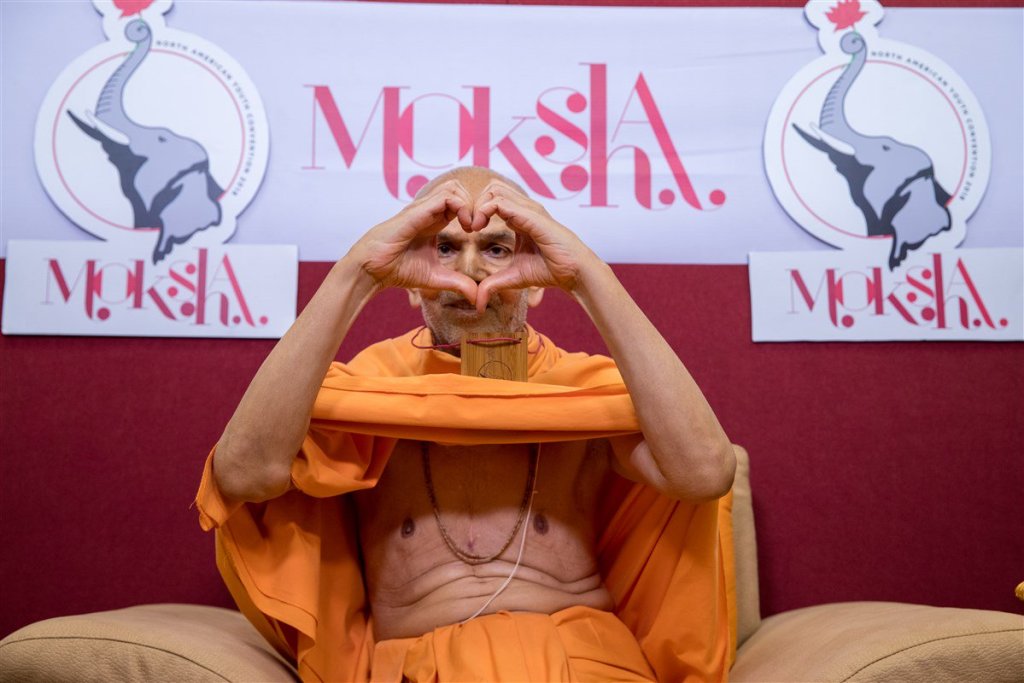
No one can compare to the love that Bapa gives us. No one can come near it. We feel it when he smiles at us, when he puts his arms up and folds his hands into a heart. We feel it, but we can’t explain it, and yet when we’re asked to do one thing, we fall short. Not because we don’t love him, but because we don’t yet understand his love. The world taught us love has conditions, love that comes with an ending we just haven’t reached yet. We spent our whole lives learning how to love people who might leave. Every “I love you” we’ve ever heard was borrowed. His is the only one that was never on loan.


Leave a Reply