
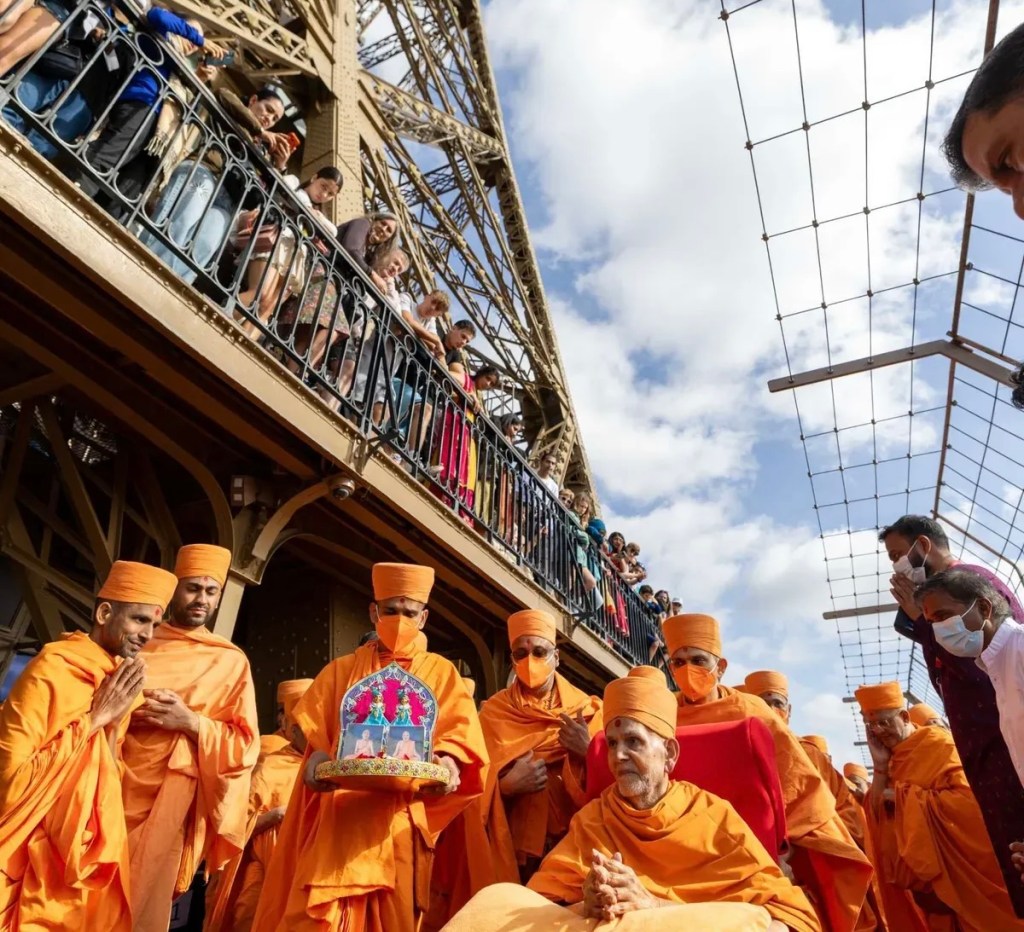
I’ve been a satsangi and a volunteer with BAPS for over seven years now. I wasn’t born into this. I started going to mandir as a teenager, with all the questions anyone has when they’re new to something rooted in ancient philosophy. I still remember what it felt like to not understand maryada at all. So this is less an explanation for anyone else and more an attempt to write down what it’s actually taught me, both as a way of practicing faith and as a woman in this sanstha.
Maryada, at its core, is a code of conduct. Boundaries that exist not to hold anyone back, but to hold something sacred in place. The eight-fold vow of celibacy that BAPS Sadhus take is one part of that. Following brahmacharya means giving up a lot, and among those things are women and wealth. As a woman, that doesn’t mean I don’t get to see a Sadhu. It means the vow keeps them from seeing any woman. It doesn’t mean I can’t speak to them or be near them. It means they’ve made a vow to keep their own distance, from all women, as part of what they’ve given up. If they break that niyam, even by accident, they observe a waterless fast, not because anyone asked them to, but because that’s how seriously they hold their own vow. As women, we choose to respect that boundary. We do our part so the Sadhus can keep the vow they’ve made.
There’s something quietly extraordinary about the life a Sadhu chooses. They walk away from everything most people spend a lifetime building, family, comfort, the small pleasures that make a life feel like theirs. And they do it on purpose, so that nothing stands between them and God. What they give up isn’t loss. It’s surrender, the kind that asks for everything and gives back a life devoted entirely to something greater than themselves.
What moves me most is what happens after that surrender. Everyone becomes equal. A Sadhu who came from wealth and one who came from nothing wear the same clothes, sleep on the same floor, eat from the same wooden bowl, everything mixed together so no single flavor gets to stand above the rest. No hierarchy, no exception, just the quiet reminder that in the eyes of God, we are all his in exactly the same way, no matter where we started or what we gave up to get here.
That boundary isn’t only about the Sadhus, though. It made me start asking what maryada is actually protecting against in the first place. The answer is kaam.
Kaam gets conflated with lust more than anything else, narrowed down to just one thing, when it’s really desire for anything outside of God, whether that’s wealth, food, career, comfort, or recognition. And it’s one of the oldest reasons people lose their way. It’s there in every scripture I’ve read and every story I grew up hearing, and the moment someone lets kaam take the wheel is usually the moment things start to fall apart. Maryada is the discipline that keeps kaam from being in charge, and I’ve watched what that discipline does, not just for Sadhus, but for how I try to live too. When you build boundaries around the things that pull your mind away from God, you get to keep your mind on God.
That discipline has shaped my experience as a woman in this sanstha more than I think people realize. I’ve volunteered with BAPS for a good chunk of my life, and the values I was taught here are the ones that shaped who I am. Things that take most people years to learn in a workplace, women in satsang start learning as children, learning to lead, to organize a room full of people toward one goal, to hold responsibility without needing to be asked twice. I know women who trace their professional skills straight back to something they first practiced running a mandir program.
None of that happens by accident, though. Growth like that only comes from a place where you feel safe enough to actually try, to get things wrong, and to keep showing up, again and again, until it becomes part of you. Looking back, I don’t think any of it would’ve stuck if mandir hadn’t felt like somewhere I belonged first. The skills came later. The sense of home came first.
Wherever I travel, I look for a BAPS mandir, because I know it’s home. Not because it’s a building, but because there’s nowhere that feels safer or more familiar. BAPS is also what connected me to my roots and gave me a way to do bhakti that feels sacred rather than performative. It taught me that giving back to the community that raised you isn’t optional, it’s a duty, one that extends to how we treat each other with respect, regardless of gender, race, ethnicity, or belief.
That duty has gone both ways for me, too. I’ve been on the receiving end of it as much as I’ve tried to live up to it. Living inside that duty is part of why I can say this honestly, as a woman, that it’s changed how I experience my own place in this sanstha.
None of this is new, either. Bhagwan Swaminarayan built it into the foundation of this faith centuries ago, at a time when the world around him treated women as something to be discarded rather than protected. Widows were expected to die alongside their husbands. Baby girls were drowned before they ever had a chance at a life. Dowry decided whether a daughter was seen as a blessing or a burden. He didn’t just speak against these things. He walked from village to village and undid them, one family at a time, teaching people that a woman who lost her husband hadn’t done anything wrong and deserved a full life of her own. He built communities where widows could live with dignity instead of shame. He opened mandirs and gave women religious education when no one else would. He ended dowry. He took it upon himself to help arrange respectable marriages for the daughters of his followers so families never felt they had to choose between a daughter and their future. He taught women to read, to run farms and businesses, to speak up in rooms that had never made space for their voice before.
I think about that history every time someone acts surprised that women thrive in this sanstha. We’re not thriving despite BAPS. We’re thriving because of a foundation someone laid two hundred years ago, on purpose, so that we could.
As a woman, I don’t feel unseen or unheard here. I feel the opposite. I’m at my best when I’m at mandir, when I’m doing seva, when I’m having darshan of Bhagwan and Guru. A lot of my sense of who I am comes from knowing I belong to Mahant Swami Maharaj in the way a devotee belongs to their Guru, and that belonging is what gives me the confidence to keep going. We know we have his guidance and his blessing. We know that even on the days we fall short, he doesn’t abandon us. We see him as ours, and he sees us as his. That relationship is hard to put into words, and so is the love women in satsang feel for Bapa. It’s a rare, uncomplicated kind of love. If you take the time to actually understand it, I don’t think anything else quite compares.
Spirituality asks for your full attention, and maryada is what protects that attention. It’s why I can walk into mandir and feel like the noise of the outside world actually quiets down. It’s why seva feels less like a task and more like a way of practicing devotion with my whole self. I don’t experience maryada as a rule I have to follow. I experience it as the thing that makes it possible to practice bhakti without half my mind somewhere else, and as a woman, it’s also what’s let me feel completely safe doing it. That’s the gift of it, and it’s the reason I keep coming back, seven years in and still learning.


Leave a Reply