
The one thing the human race will never stop doing is exploring. We keep learning, we keep explaining the inexplicable, and we keep finding out that what we once thought was impossible is possible after all. Just when we think we know close to everything, we realize we know absolutely nothing. The truth is that we will never know everything. We will only know what we were taught to be true, what we reasoned our way into, and what added up in our own heads and what we logically accept.
But what even is logic? Not the western definition, and not the dictionary definition. Truly, what is logic? What is reason? What does it mean to really understand something? As people, we are all fundamentally different. We have lived very different lives, and those lives have taught us very different lessons. One person can comprehend and reason through something that another cannot, and that does not make the second person stupid or incapable of logic. It just means the first person has lived through the experiences and learned the lessons that let them think it all the way through.
So what do we do when someone else has reasoned their way to something we don’t have the knowledge to follow? Do we accept that we fall short somewhere and take their word for it? Or do we try to understand as much as we can, so that we aren’t blindly believing someone who claims to have reasoned it out? And in doing that, are we using faith or are we using logic? Do we trust that it’s true because they know more, or do we work to understand it for ourselves?
Which brings us to the bigger question: what is faith, and what is logic? Logic is reason. Faith is something deeper. Faith is believing in something or someone so strongly that at times it outweighs logic. But that creates a problem. If faith can outweigh logic, and logic is reason, then the two must be so different that they can’t mix. Theoretically, that is true. But it is also what we have been fed since birth: that logic and faith are opposites, and that one requires the absence of the other.
Yet in Satsang, one complements the other. In no other corner of the world will you find a place where faith complements logic and logic complements faith. We live in a world that prides itself on its reasoning, on its ability to innovate at an incredibly complicated level and discover what was deemed impossible, and in that same world faith is looked at as irrational, as something that doesn’t explain anything. Somehow, Satsang has brought these two seemingly opposite ideas together.
Pramukh Swami Maharaj said, “Satpurushne sodhva mate buddhi vaparvi, pan Satpurush mali gaya pachi buddhi baju par muki dev,” meaning “Use your intellect to search for and verify the Satpurush, but after finding him, put your logic aside.” You would think that in the realm of religion and spirituality, words like logic, reason, and most importantly verification would have no place at all. Yet in Satsang we are encouraged to think rationally and to understand whether we have truly found the Satpurush. We are told to use our brains instead of believing blindly. But once our intellect and curiosity have been convinced, we proceed with faith.
So what does it actually mean to use our intellect? It doesn’t mean reasoning about everything we can’t see. It means using our eyes and our reason on what is in front of us and asking honestly whether it is true. We already live this way. We trust the bus schedule because we’ve watched it work, and we trust the green light because we understand why it exists. Trust that comes from something we’ve seen is the steadiest kind.
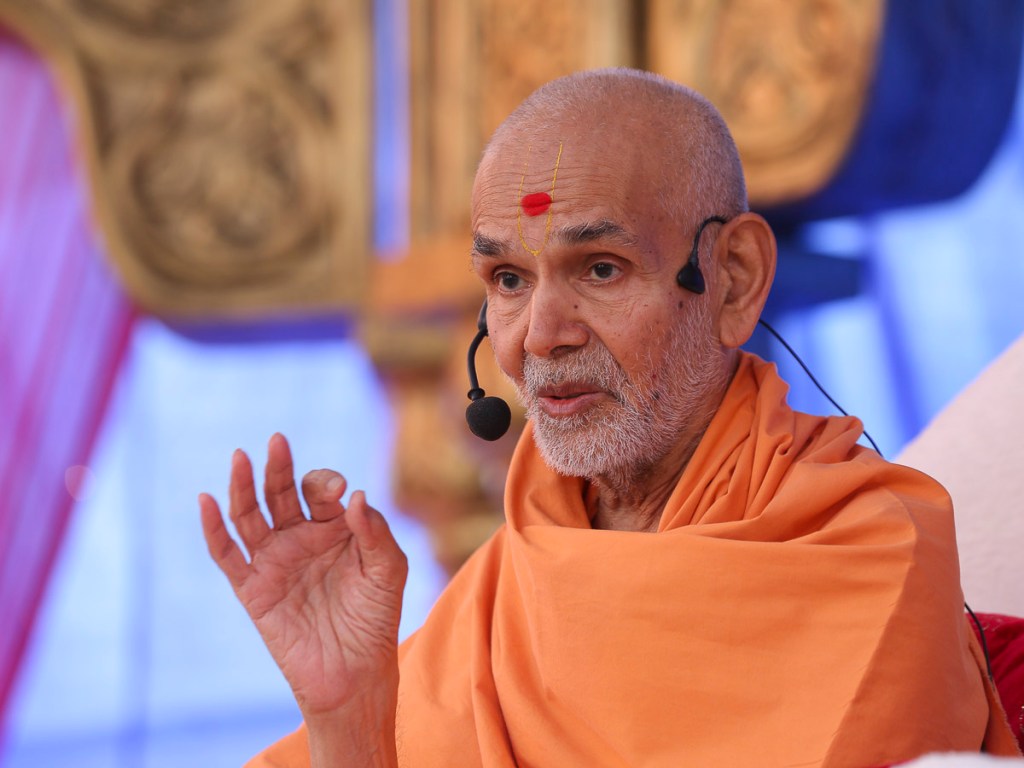
Mahant Swami Maharaj often reminds us that we can see our prapti, what we have attained, and we can. We get to watch a person who has no attachment to this material world, who is attached only to God, and who wants nothing more than to see us happy and successful. We get to watch infinite compassion in how he lives. This is not someone ordinary, and we don’t have to take anyone’s word for it. We can see it.
Maharaj speaks to this in Kariyani 2. He describes one person who, since joining Satsang, may occasionally perceive a flaw in God or the Sant, but it never lasts. It passes. He stays, because he is wise enough to realize there is no Sant like this in the entire universe. Then Maharaj describes another whose intellect looks similar and whose faith looks similar, yet who keeps perceiving flaws, and he asks what fault there must be in that person’s intellect. Notice where the question points. It doesn’t point at the Sant. It points at the lens.
Gadhada 1-57 explains why the lens matters, and it asks us to separate two things that sound alike but aren’t. The first is logical conditions. This means looking at divinity through a human lens, with our own moods, expectations, and standards for how a Sant should be. Seen that way, we are bound to go looking for flaws, and love built on that foundation breaks the moment one appears, which is why Maharaj says it cannot be trusted. The second is logic, which is simply reason. Logic doesn’t ask whether God measures up to our standards. It asks what is actually in front of us. The scriptures describe a Satpurush as someone who embodies thirty-nine divine qualities, and when we see those qualities in a living person, reason leads somewhere honest: this person must be divine. That is logic doing its work. Our faith grows stronger because we reasoned our way to it ourselves, and it rests on understanding, so it doesn’t depend on how we feel on a given day. Once that conclusion is settled, the rest is faith. This is the love Maharaj describes as born from realizing God’s greatness, which is of a totally different nature from the first.
Once it is settled, something changes. Faith stops being something we have to defend and becomes something we stand on. When we love God because we know this is what is true, no person and no circumstance can take that from us. And it changes how we see everything else. Satsang looks different, our days look different, and we find ourselves more grateful for what we’ve been given. That is how prapti becomes pratiti: what we have attained slowly becomes something we feel.
Think of it as walking a dark path with a lantern. We use the light carefully at the start, because we want to be sure we’re following the right person. But once we’ve found him, we don’t keep holding the lantern up to question every step. We walk beside him, and the road starts to feel right. Slowly, it starts to show itself. And somewhere along the way, it starts to feel like home.


Leave a Reply